- Zack works with organizations to enhance efficiency, improve productivity, and bolster employee satisfaction at reduced costs by harnessing the power of AI
- Demystifies complex AI concepts and helps teams grasp both the essence and potential of AI to drive growth, innovation, and workforce transformation
- Focuses on ethical implementation of AI and optimizing human-centered skills for sustainable success
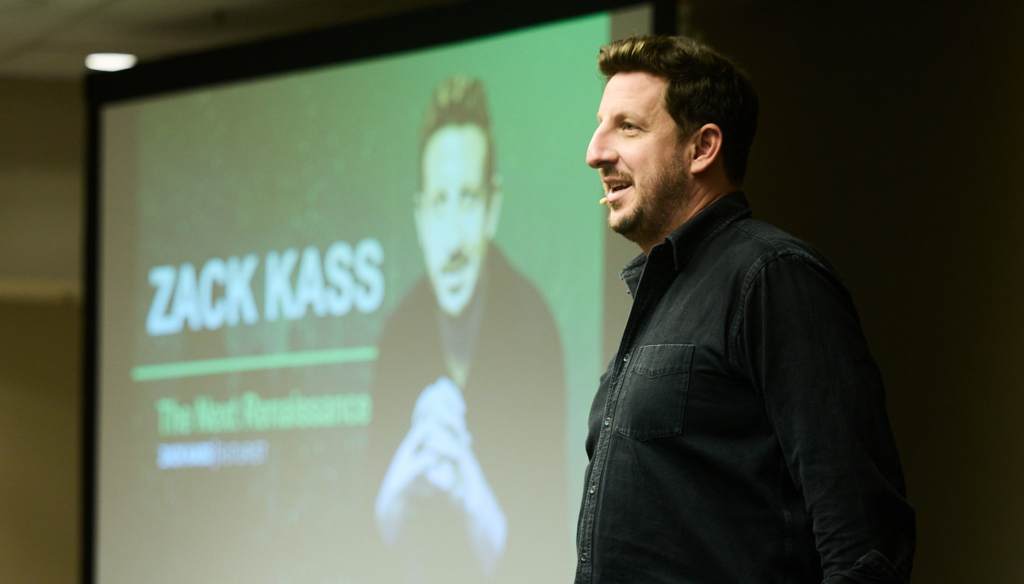
Check fees and availability for Zack Kass
About Zack Kass
Download ProfileZack Kass is a global AI advisor and the former Head of Go-to-Market at OpenAI, where he built the company’s sales, solutions, and partnerships teams. Today, he advises Fortune 1000 companies and governments on how to lead in an AI-driven world and collaborates with the University of Virginia to explore AI’s socio-economic impacts. His new book, The Next Renaissance: AI and the Expansion of Human Potential, is available for pre-order now and will be published on January 13, 2026. Through his work, Zack’s mission is to demystify AI and build a brighter future
Video Gallery

Zack Kass: Speaker Reel

Zack Kass: Future-Proofing Your Organization

Zack Kass: The Future of Living
Zack Kass: Speaker Reel
Zack Kass: Future-Proofing Your Organization
Zack Kass: The Future of Living
Speech Topics
Download TopicsIn the age of Artificial Intelligence, everything is changing, from how we work to how we create. How can you take advantage of this change to improve your life and career? As the former Head of Go To Market for OpenAI, Zack Kass has been at the forefront of AI’s global transformation for over 15 years. In this compelling keynote, Zack counters the conventional dystopian narrative of AI, sharing a positive vision that offers the potential for game-changing innovation, opportunity, and human potential. Audiences will come away understanding how technology will reshape their industries, organizations, workforce, and lives for the better.
Zack Kass begins with a question: If you could automate everything in your life, where would you stop?
The answers are inconsistent. We are quick to give away the things we call chores, yet we hold onto others that are inefficient, uncomfortable, even dangerous. Some effort we avoid. Some we defend. The distinction is not logical, it is emotional and deeply human—shaped by instinct, habit, and culture more than reason.
Kass calls this line the automation boundary.
The boundary does not hold. It moves—quietly, and often without notice. A decision is made for you. A task disappears. Something becomes easier, and you accept it. Not through deliberation, but by default. In a world saturated with choice, much of what we describe as preference is little more than pattern. When something else can decide faster, with less effort, we tend to let it.
That is how the boundary shifts.
For most of history, that movement has defined progress. Reducing friction—time, effort, constraint—has made life longer, safer, more stable. It has lowered poverty, extended lifespans, and expanded access to the basic conditions of modern life. But not all friction is waste. Some of it produces something essential in return. It builds strength. It sharpens judgment. It deepens relationships. It turns effort into capability.
Most economic and technological systems do not distinguish between the two. They push in one direction: faster, cheaper, easier. Left alone, they will remove both—the friction that limits us, and the friction that defines us.
Which means the boundary will not hold itself.
What remains human is not what resists automation. It is what we choose to keep—deliberately, and often against the logic of efficiency.
For most of modern history, work has been organized around a simple constraint: human capability is scarce. Skill, knowledge, and time are unevenly distributed, and organizations are built to manage that scarcity—through hierarchy, specialization, and process.
That constraint is weakening.
Artificial intelligence does not just change what tools can do; it changes how work gets done. Tasks that once required training, coordination, or scale can now be executed by far fewer people, often in a fraction of the time. The bottleneck is shifting—from capability to judgment.
This creates a different kind of organization.
Small teams begin to operate with the leverage of much larger ones. Roles blur. The distance between idea and execution compresses. Work that was once fragmented across functions becomes continuous. Increasingly, advantage comes not from access to resources, but from the ability to direct them.
At the same time, the best companies are not making technology more visible—they are making it disappear. The most effective systems are not the ones employees have to think about, but the ones embedded directly into how work gets done. Intelligence becomes ambient: present in workflows, decisions, and interactions, rather than confined to tools.
The transition is uneven. Some work disappears. More of it reorganizes—sometimes quickly, often uncomfortably. The deeper challenge is not economic, but psychological. For many, work is more than income; it is identity, structure, and meaning. As tasks change, so does the question of where people create value.
At the same time, a different opportunity begins to take shape. As routine work recedes, more time becomes available for judgment, creativity, and human interaction—the parts of work that do not scale easily, and therefore matter more.
The future of work will not be defined by the tools themselves, but by how organizations and individuals adapt to them. Those who learn to work with these systems—rather than around them—will move faster, operate with more leverage, and create disproportionate impact.

Related Links
The Next Renaissance: AI and the Expansion of Human Potential
View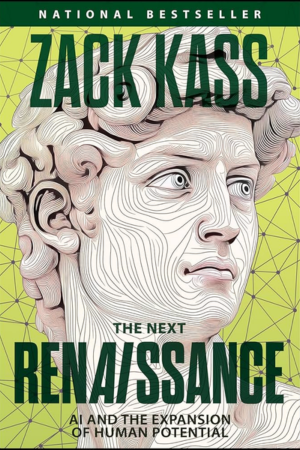
Big Ideas in 24 Hours
Our veteran team is standing by to help with big ideas and real perspective. Call us at +44 20 3038 4689, email us at [email protected], or click below for a custom speaker proposal.
Similar Speakers


Peter Sheahan
World-Renowned Speaker on Exploiting Business Trends and New Market Opportunities
 LAI Exclusive
Noelle Russell
Leading AI Innovator & Practitioner, Founder & Chief AI Officer at AI Leadership Institute
 LAI Exclusive